
AI for operational excellence: what twelve use cases delivered, and what still needs proof
In Work Package 6 (WP6), 30 partners tested AI in day-to-day industrial operations across twelve Tier 2 use cases, UC9 to UC20. Each use case set its own measurable targets, and most report several of them as achieved or exceeded. WP6 singles out six use cases, UC11 to UC15 and UC20, as having overachieved. The results range from improvements measured in running production to proofs of concept, simulations and benefits still under validation, and this article keeps those categories apart.
The industrial problems and WP6's scope
The use cases cover three fields: production planning and control, material handling and logistics, and maintenance and quality control. Most sit in semiconductor manufacturing, while an indoor farming demonstrator (UC11) and an RF transceiver line (UC16) extend the work beyond the fab. The team names data quality and availability, data integration, return on investment, scarce domain expertise and the transfer into high-volume production as its main obstacles.
UC10 connects much of this work. It developed an AI-based concept for the manufacturing execution system (MES), the software layer that tracks and controls production, and links UC9, UC12, UC15, UC17 and UC20. Three of its four targets are reported as achieved, including a cycle time reduction of more than 10%.
Production planning and energy-aware scheduling
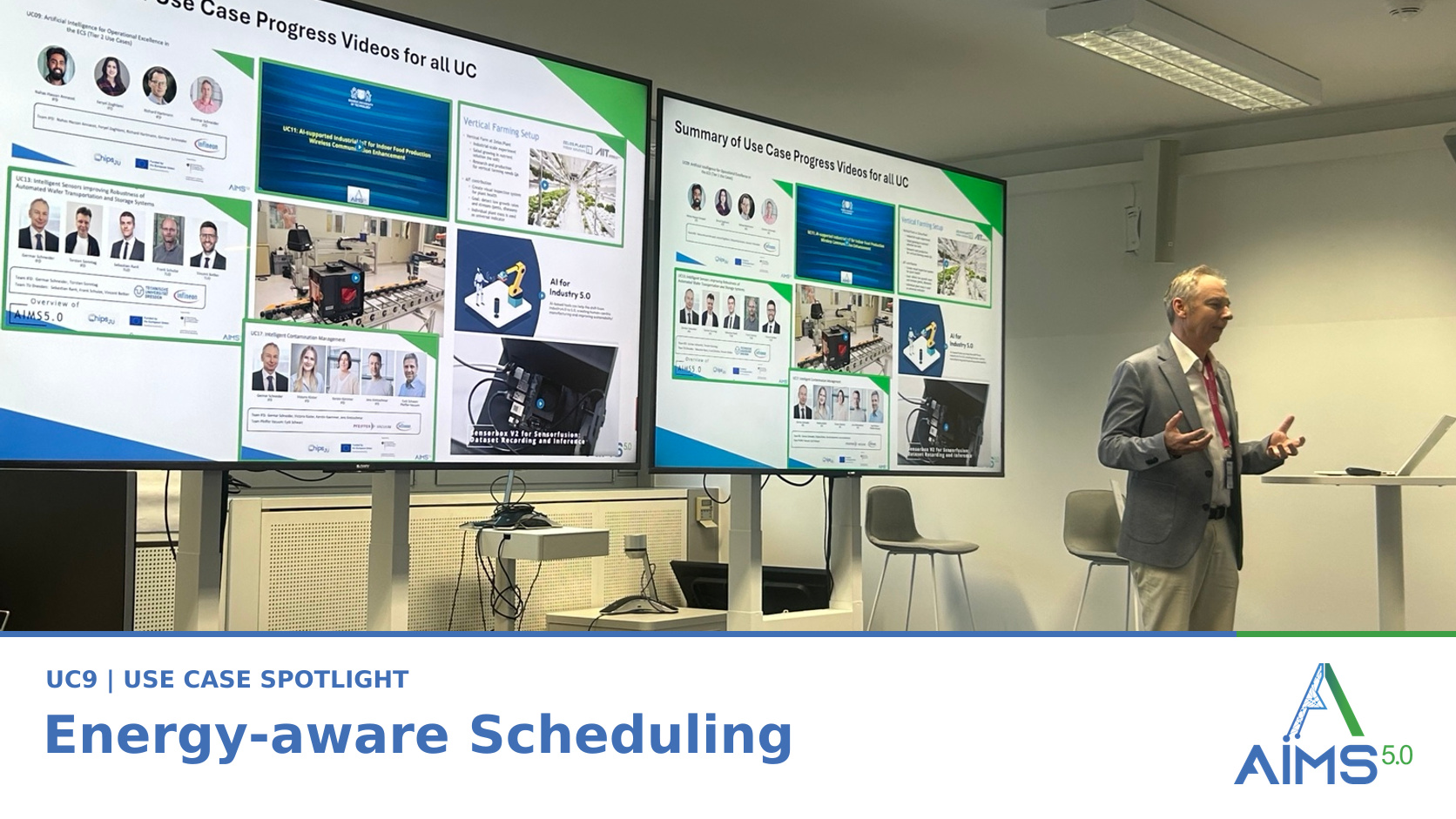
UC9 looked at batch processing machines, which treat several lots at once, so the way work is grouped affects both delivery performance and energy demand. Using genetic programming, a method that evolves scheduling rules automatically, the team improved total weighted tardiness, a measure of how late lots finish, weighted by priority. In the wafer facility area at Infineon Villach, energy flows were simulated, and the models reached 98.6% accuracy in detecting and predicting anomalies in the cooling network.
In UC12, overall equipment effectiveness (OEE), the share of planned time in which equipment produces good output, increased by approximately 34% in a selected work centre, exceeding the target. Further variability reductions come from scenario analysis and are still being validated.
Planning also extends to the supply chain. UC19 generates baseline master plans for one product group in about three minutes against a five-minute target, and its plans proved up to about 40% more stable than plans based on linear programming. Other UC19 targets are partly reached so far, with backlog down by about 20% and about 40% less time needed to retrieve root cause data. UC18 built semantic data models for economic and ecological supply chain decisions, including a draft carbon handprint model; these are still being evaluated with stakeholders.
Transport, maintenance and virtual commissioning
Automated systems move wafers through the fab around the clock, and in UC13 their maintenance relied heavily on manual work. A single transport vehicle for 300 mm wafers is highly expensive, so early fault detection matters. UC13 added intelligent sensors and a new sensor platform at Infineon Dresden. The WP6 lead clarified that the KPIs were ultimately overachieved, although later than originally planned. A roadmap towards predictive maintenance is in place.
UC14 moves away from linear, slow commissioning towards virtual commissioning, in which automation equipment is tested against a digital twin before and during installation. In the first on-site commissionings at a customer site, setup and test time fell by around 20%, although equipment and twin were still demonstrators. A 33% reduction is expected for a robot cell, and handover to the customer could come about eight weeks earlier; both are projections. Alongside this, the FlatStocker 3.0 storage system was tested, the HERO-SCOUT mobile robot was evaluated at Infineon and machine-learning-based travel-time estimation for fleet management was implemented.
Quality, machine learning and resource efficiency
At the start of the project, machine learning in UC15 was exploratory, with no unified infrastructure and manual data handling. UC15 now has an MLOps infrastructure, the tooling and practices for developing, deploying and monitoring models in production. It reports its targets of 70% less model development time, 20% less data to scale a model to new machines, 50% less monitoring time and a 25% shorter mean time to recovery as exceeded. Gains in component lifetime and maintenance effort are still under validation.
UC16 reports all four of its targets for RF transceiver production as achieved, including 20% less redesign time and 10% fewer consumables and chemical waste. UC17 installed new contamination sensors in a 300 mm fab, and Fraunhofer IISB added heatmaps that make offline metal contamination measurements easier to evaluate; the efficiency effect is not yet fully evaluated. UC20 harmonised test wafer processes between the Villach and Dresden sites, reaching a 76% harmonisation level against a 75% target and its cost target, with fewer test wafers needed.
In the UC11 indoor farm, the system detected visual plant irregularities with accuracy and recall above 90% and improved wireless signal quality by about 6 dB, well beyond the target. Its energy measurements with and without the AI module are still being analysed.
Lessons for adoption and further deployment
WP6's lessons are direct: tasks that look simple can become complex once AI is involved, so plan resources generously, and continuous risk monitoring with measurable KPIs helps more than long reports. Skills matter as much as tools; UC18 trained 20 intern modellers and two PhD students who were subsequently hired.
Several benefits still need confirmation, including component lifetime in UC15, the efficiency effect in UC17, variability reductions in UC12 and the projected commissioning savings in UC14. For companies planning similar steps, the sequence is clear: fix data access and harmonisation first, define measurable KPIs before deployment, and budget for the extra effort that simple-looking AI tasks need.








 Imprint
