
AIMS5.0 Deep Dive, part 2 of 9 · Work package 2: AI tools, methods and algorithms for sustainable industrial processes
Companies that want to use AI in production can choose from thousands of models and libraries online. What they usually miss is guidance: which method fits a given production problem, and what it takes to get it running on the shop floor. Work package 2 (WP2) of AIMS5.0 worked on both questions. It was led by Pál Varga of the Budapest University of Technology and Economics (BME) and Kārlis Freivalds of the Institute of Electronics and Computer Science (EDI) in Latvia.
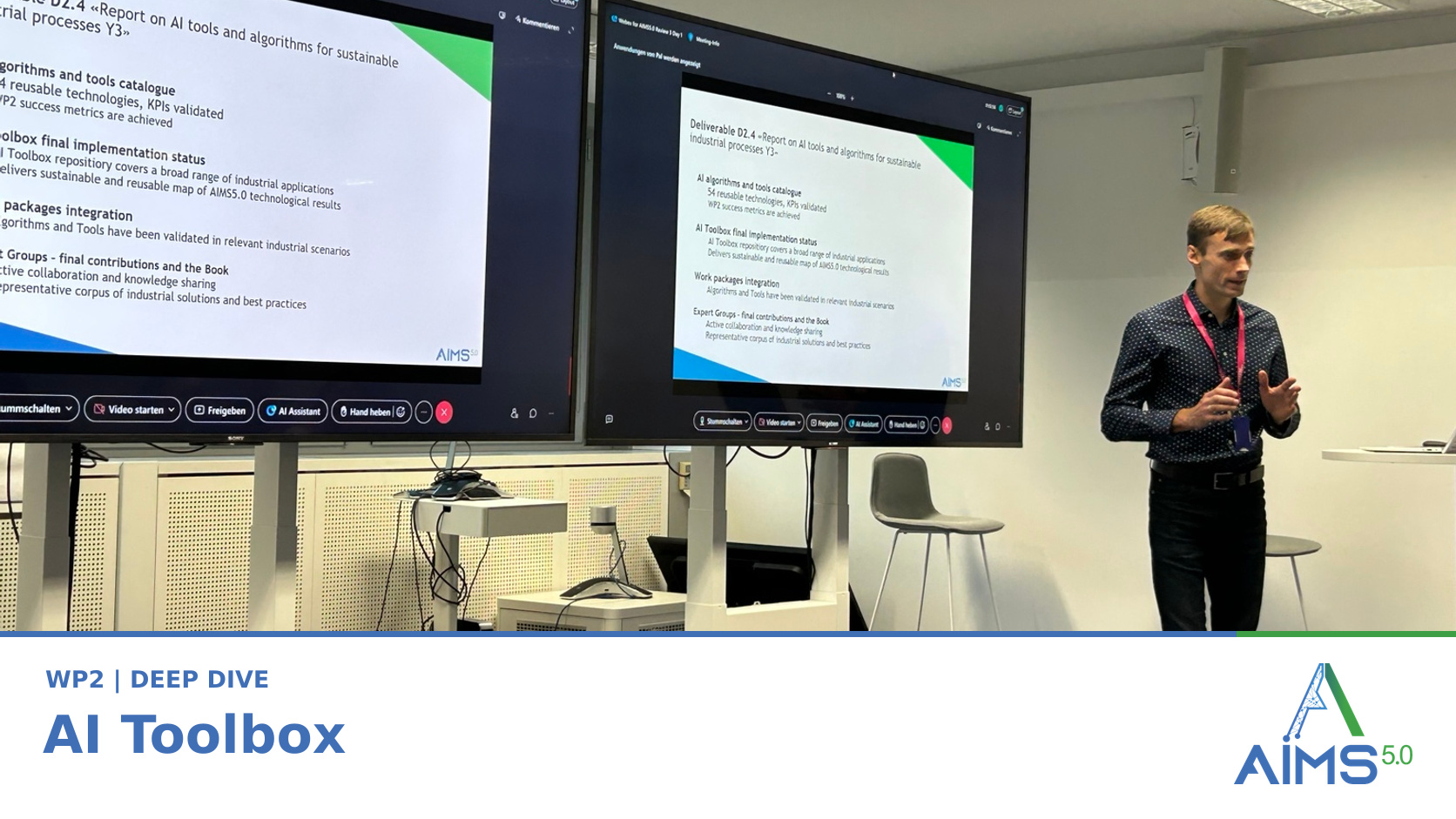
The work package had a practical brief. It collected the requirements of the 20 industrial use cases, developed and refined AI algorithms to meet them, supported their integration into the use cases, and measured the gains. At the same time, it built a repository of AI methods, tools and algorithms that companies outside the consortium can reuse. The final results are documented in deliverable D2.4.
54 technologies in six areas
Over three years, WP2 produced 54 reusable AI technologies. Most of them were validated directly in the use cases.
|
Area |
Technologies |
Examples from the use cases |
|
Robotics, automation and process management |
16 |
AI-enabled manufacturing execution system, virtual commissioning with a digital twin, digital Kanban |
|
Reinforcement learning, optimisation and scheduling |
13 |
Energy-aware scheduling, supply chain master planning, robot arm feedback control |
|
Large language models and NLP |
8 |
Robot control script synthesis, LLM-based root cause analysis, automatic ontology learning |
|
Image processing |
7 |
Socket detection for robotic feeding, LED assembly monitoring, visual plant mass estimation |
|
Machine learning models and techniques |
6 |
Quality control models, faster RF design, AI-based decision support |
|
Anomaly detection and predictive maintenance |
4 |
Tool breakage detection in milling, defect classification, test wafer harmonisation |
What the methods achieved
WP2 tracked its progress with a set of success metrics agreed at the start of the project, each linked to the use cases that address it. The results show what the methods do in practice.
For prediction and detection, a vision system for robotic conveyor feeding finds sockets with 98.7% accuracy and a position error of 2 mm. A model for tool breakage detection in milling reached 99% accuracy in the lab. New sensors and methods for cleanroom monitoring cut the reaction time to contamination from eight hours to under one.
For flexibility, control scripts for a new robot task are now generated in 30 to 45 minutes, and more than 90% of them run correctly. In semiconductor manufacturing, a shared MLOps platform made the development of machine learning models about 75% faster, and transfer learning reduces the data needed to scale a model to new machines by an estimated 25%.
For sustainability, machine learning at FORTH halved the time needed to redesign RF components. With a sustainability monitoring protocol in place throughout the project, consumables and chemical waste went down by 45%, well beyond the original target of 10%.
The AI Toolbox
The knowledge from WP2 is collected in the AIMS5.0 AI Toolbox, a public wiki hosted by BME at aitoolbox.tmit.bme.hu. It documents 41 tools and 17 industrial examples. For each tool you can see what it does, in which use case it was applied, and what the developers learned along the way.
The Toolbox follows a simple structure. At the algorithmic level, it covers methods such as classification, clustering, regression and dimension reduction. At the tool level, it offers building blocks such as time series and sensor prediction, person and asset localisation, and language functions. At the application level, it shows complete examples, from predictive maintenance of railway switches to geofencing for conveyor belt safety. A user moves from assessing the problem to training, customising and deploying a solution.
Some tools are deeply integrated and can be deployed directly, including notebooks. Others are integrated more loosely, with documentation and deployment guidelines. The concept was presented at IEEE CNSM 2023 and IEEE NOMS 2024, and studies on the barriers to AI adoption in Industry 5.0 followed at CNSM 2024 and IFAC 2025.
Book and journal special issue
The WP2 expert groups also wrote a book, AI in Industry 5.0: from Machine Learning to LLM applications. Its chapters cover machine learning, image processing, anomaly detection and predictive maintenance, robotics and process management, reinforcement learning and scheduling, and large language models in industry. For the research community, a special issue of the Infocommunication Journal, Industrial AI for Industry 5.0: Methods, Deployments and Lessons from the AIMS5.0 Project, edited by Pál Varga, Kārlis Freivalds, Gian Antonio Susto and Péter Olaszi, brings the results together.
Workshops in Hungary
The work also reached people outside the project. In Hungary, the "Telecoms and AI" workshop series ran alongside AIMS5.0 for three years: 23 afternoon workshops with 120 to 200 participants each and more than 180 speakers. All recordings are on YouTube. AIMS5.0 results were also presented at AI Hungary, the national symposium on artificial intelligence.
The WP2 team will be at the AIMS5.0 booth at EFECS 2026 in Helsinki on 2 and 3 December. An overview of all nine work packages is available in the AIMS5.0 final results article.
The AIMS5.0 project is supported by the Chips Joint Undertaking and its members, including top-up funding by National Funding Authorities from involved countries under grant agreement no. 101112089.




 Imprint
