
AIMS5.0 Deep Dive, part 1 of 9 · Work package 1: Components for the Edge
Before an AI model can improve a production process, the data has to come from somewhere. It has to be measured reliably, processed fast enough on site and passed on without delay. In AIMS5.0, this was the task of work package 1 (WP1). Led by the University of Lübeck, the partners developed hardware, firmware, middleware and tools that allow AI to run close to the machine, where the data is created.
WP1 started with clear targets: higher quality and reliability of hardware components, faster and more efficient low-latency communication in the industrial internet of things, higher overall productivity, and better predictive maintenance and lifecycle management of silicon. The work was organised in five tasks, from cross-WP co-design to processing and communication hardware, sensors, firmware and deployment tools, and test and validation. Four deliverables document the results, from the first exploration of edge hardware (D1.1) to the final summary of AI-ready edge hardware and systems (D1.4).
Designed together with the other work packages
WP1 did not develop hardware in isolation. Hardware, AI methods, middleware and platform services were co-designed with work packages 2 to 4 and then validated in the industrial use cases of work packages 5 and 6. One example is a smart wristband application built on Eclipse Arrowhead. Infineon combined motion sensing with sensor fusion and raised the accuracy of gesture detection from about 70% to about 90%, with a stable update rate of 50 Hz across several devices. Another is a portable edge analytics setup that brings ROS2, audio processing and RISC-V support together.
Sensors
In a semiconductor fab, the partners improved the RFID system that tracks material through production. It reached a read accuracy of 99.68% over more than 18 million reads. Acoustic monitoring of the overhead transport system detects faults early and helps prevent downtime.
Thales completed miniature RF MEMS leakage sensors, including full RF characterisation. They protect components that are not designed for high-power signals, with much lower insertion loss and power consumption than the reference design. FORTH designed and fabricated on-chip temperature sensors based on surface acoustic waves for high-power transistors and amplifiers. The team used AI-supported methods for the characterisation and reduced the amount of gold needed.
Connectivity
Data from the shop floor is only useful if it arrives in time. Gdańsk University of Technology built a low-cost, scalable testbed for wireless communication. It uses a smart antenna and 36 beacons and can be orchestrated remotely to test interference, adaptivity and signal quality. AITIA developed a virtualised validation platform for 5G standalone campus networks, built on open-source components. It measures quality of service across authentication, sessions, handover, mobility and network slicing.
Data pipelines and model management
Stream Analyze extended its edge analytics engine with ROS2 interfaces, audio processing and RISC-V support. The engine now runs on x86, ARM and RISC-V from one code base. For autonomous lawnmowers, the effort to manage the lifecycle of the AI models went down from about 40 days to just over three.
For machine tools, Savvy Data Systems, IDEKO, Soraluce and Goimek built a multi-layer system that combines edge, fog and cloud processing for data streams of very different frequencies. Data acquisition on the shop floor became 20 times faster, and tool failures can be detected. DAC.digital delivered an MLOps framework for the full lifecycle of an industrial model, with automated data annotation, training workflows, data traceability, machine unlearning and deployment at the edge.
Monitoring and advanced manufacturing
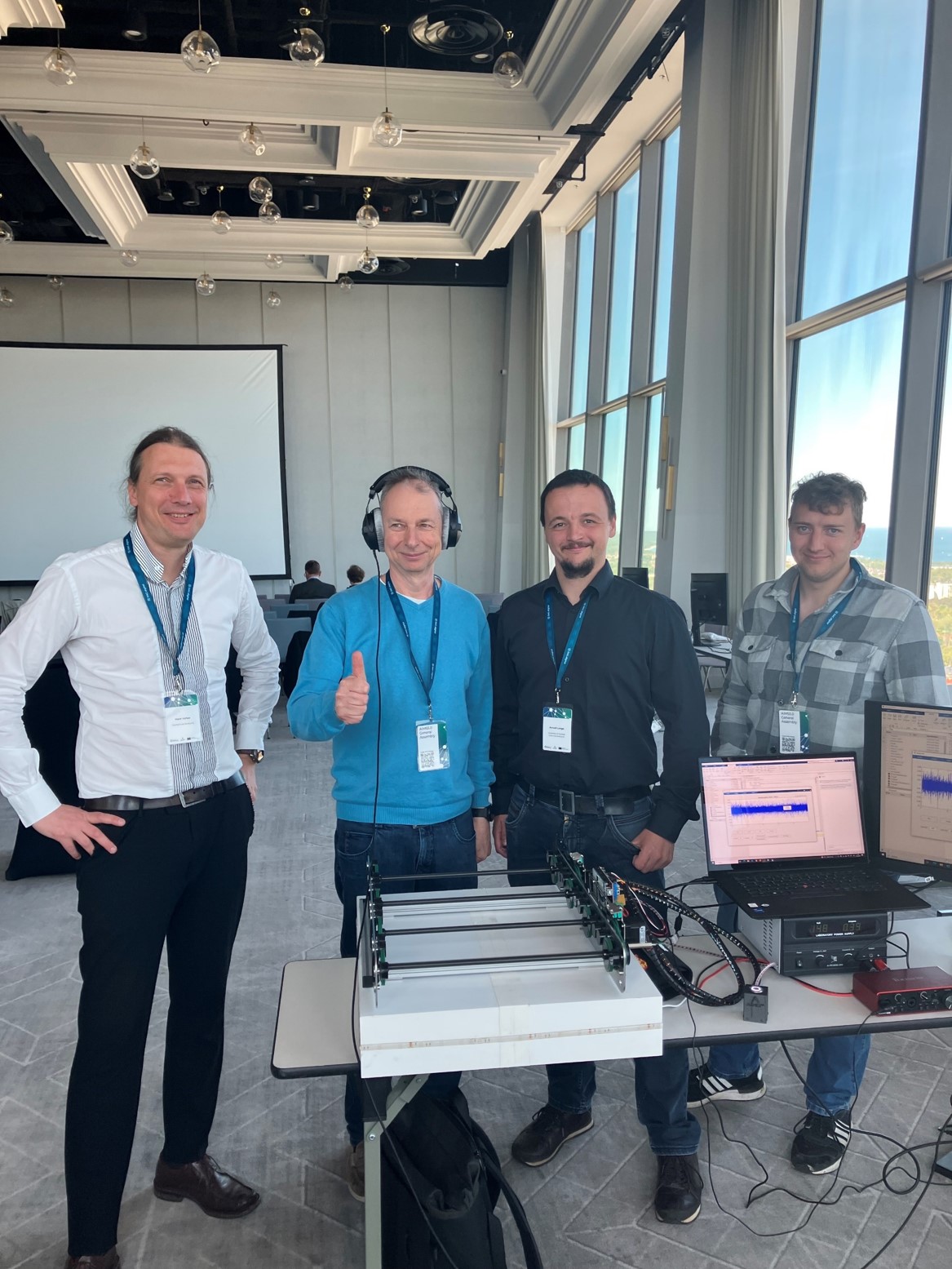
The University of Lübeck and Infineon developed a mobile sensor platform for cleanrooms. It fuses data from a time-of-flight camera, radar and LiDAR on an embedded GPU and detects people and tools, including their distance and speed. Processing speed rose from about 3.5 to about 15 frames per second.
Signify built a first-of-its-kind metal 3D printer for luminaire parts, based on directed energy deposition. Cameras for visible light and thermal imaging monitor the process and allow it to adapt in real time. For conveyors in semiconductor fabs, which move slowly in noisy surroundings, Infineon, Hochschule Stralsund and TU Dresden chose piezoelectric sensing to detect damage early, with models that are retrained as new data arrives.
People and robots
In many factories, robots and people share the same floor. Smart Universal integrated a depth sensor, radar and stereo camera on a mobile robot. Its AI-based perception detects people within five metres with more than 95% accuracy and recognises five types of gestures.
TÜBİTAK BİLGEM developed an explainable traffic management system for mobile robots in factory logistics. From 3.2 seconds of a worker's movement, it predicts the next 4.8 seconds, so the robot can avoid people early instead of stopping. The same team built a controller that reads EEG and EMG signals to estimate the movement a person intends and to steer an industrial exoskeleton. In tests with five participants, it reached an average classification accuracy of 81%.
Tested, validated, reusable
A common test and validation framework, published with deliverable D1.3, ensured that each component was checked in the industrial scenario it was built for. WP1 reached its objectives without major delays or deviations.
What remains are validated building blocks that companies can integrate beyond the project. Several are already part of other AIMS5.0 results, such as the servitization use case at Husqvarna and the automated wafer transport use case in semiconductor manufacturing.
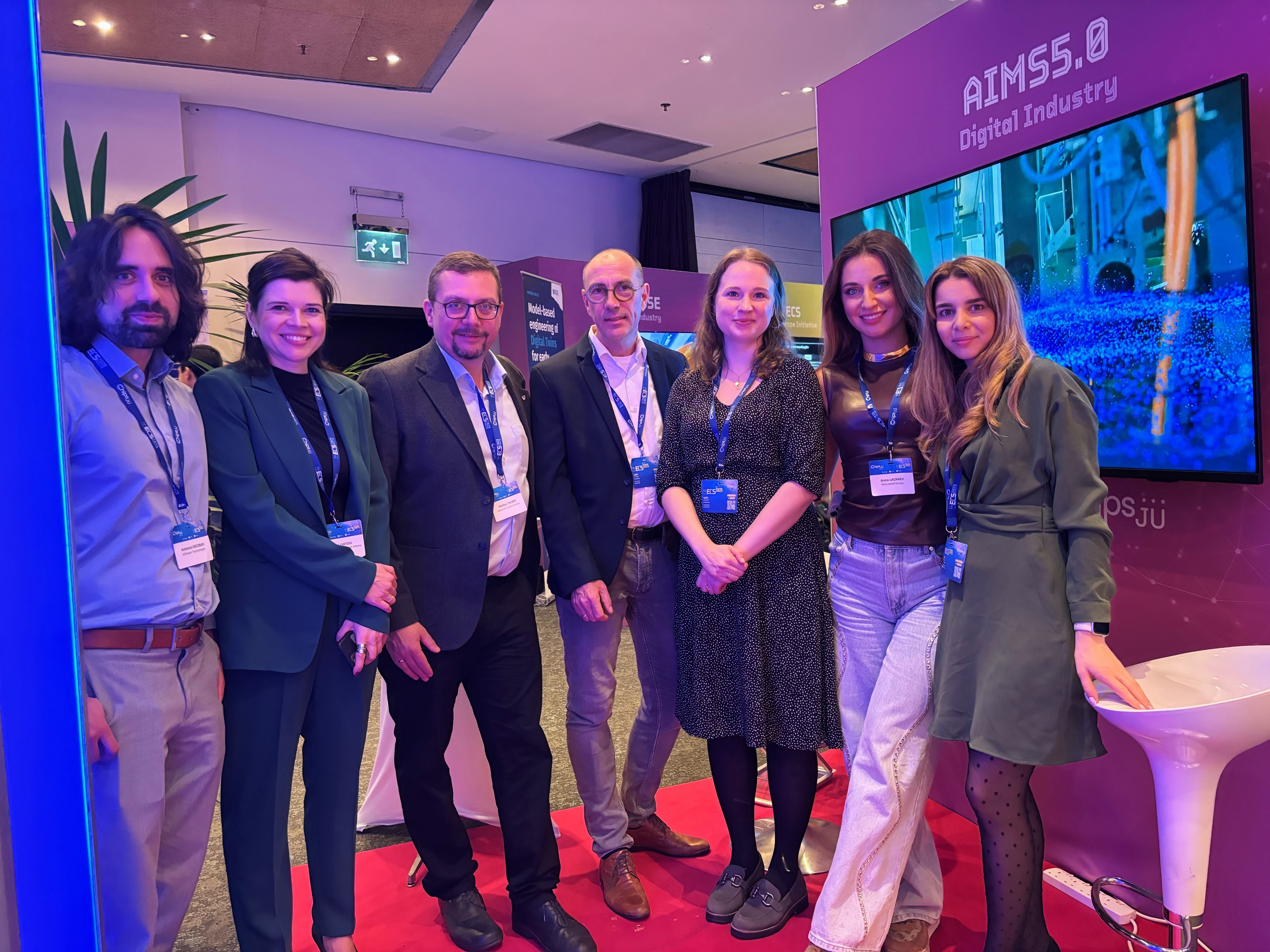
The WP1 partners will be at the AIMS5.0 booth at EFECS 2026 in Helsinki on 2 and 3 December. An overview of all nine work packages is available in the AIMS5.0 final results article.
The AIMS5.0 project is supported by the Chips Joint Undertaking and its members, including top-up funding by National Funding Authorities from involved countries under grant agreement no. 101112089.






 Imprint
