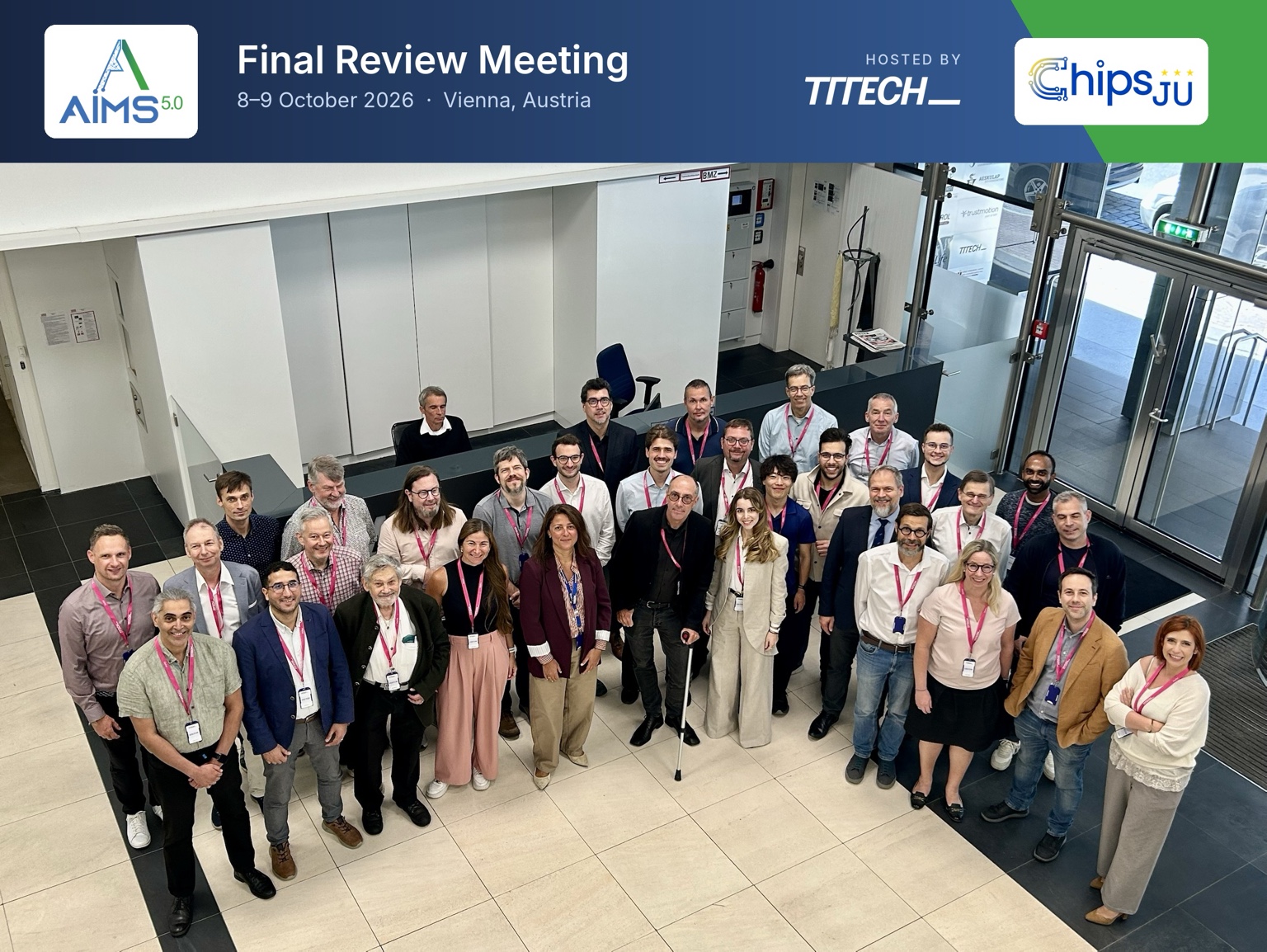
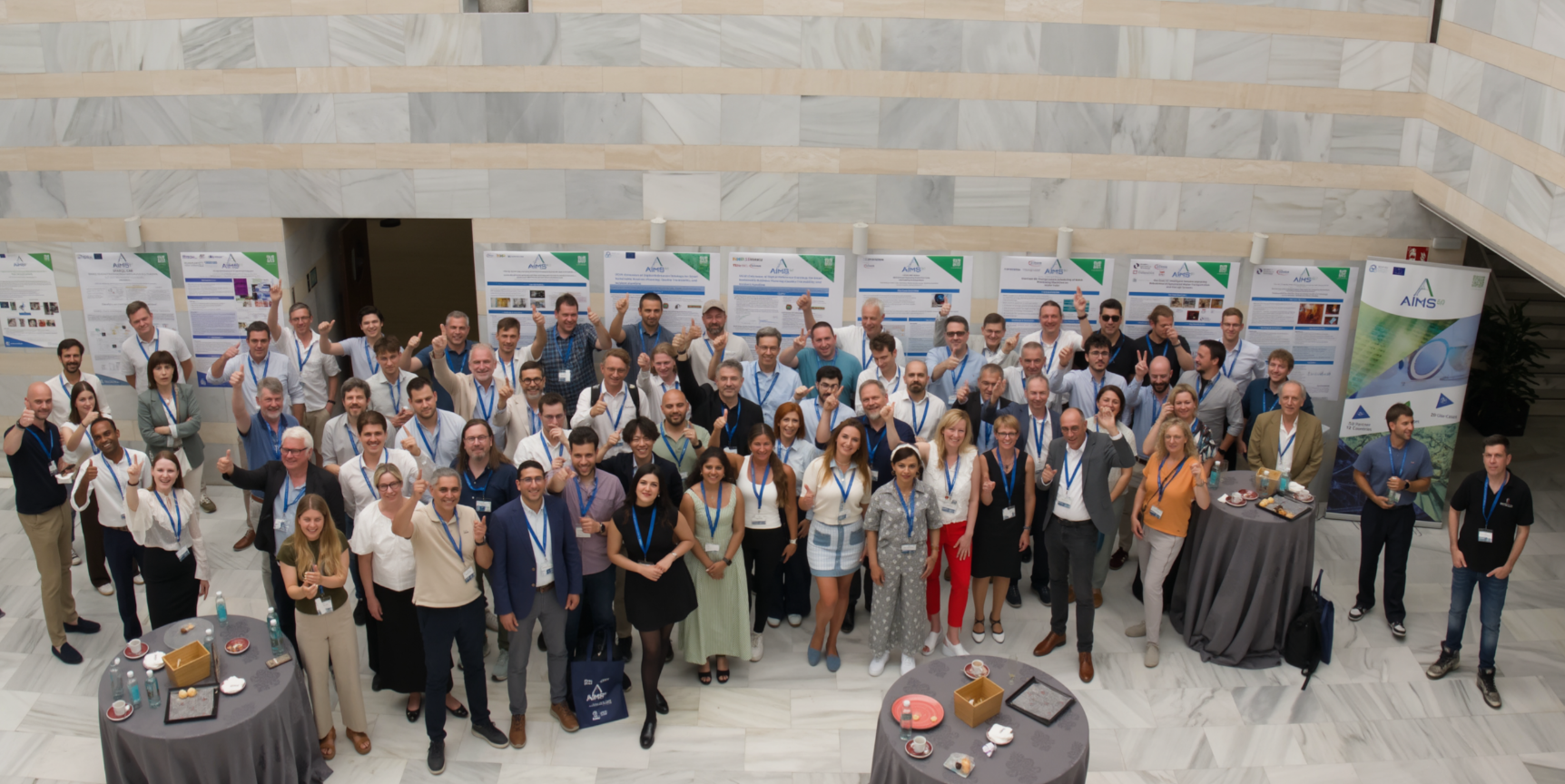
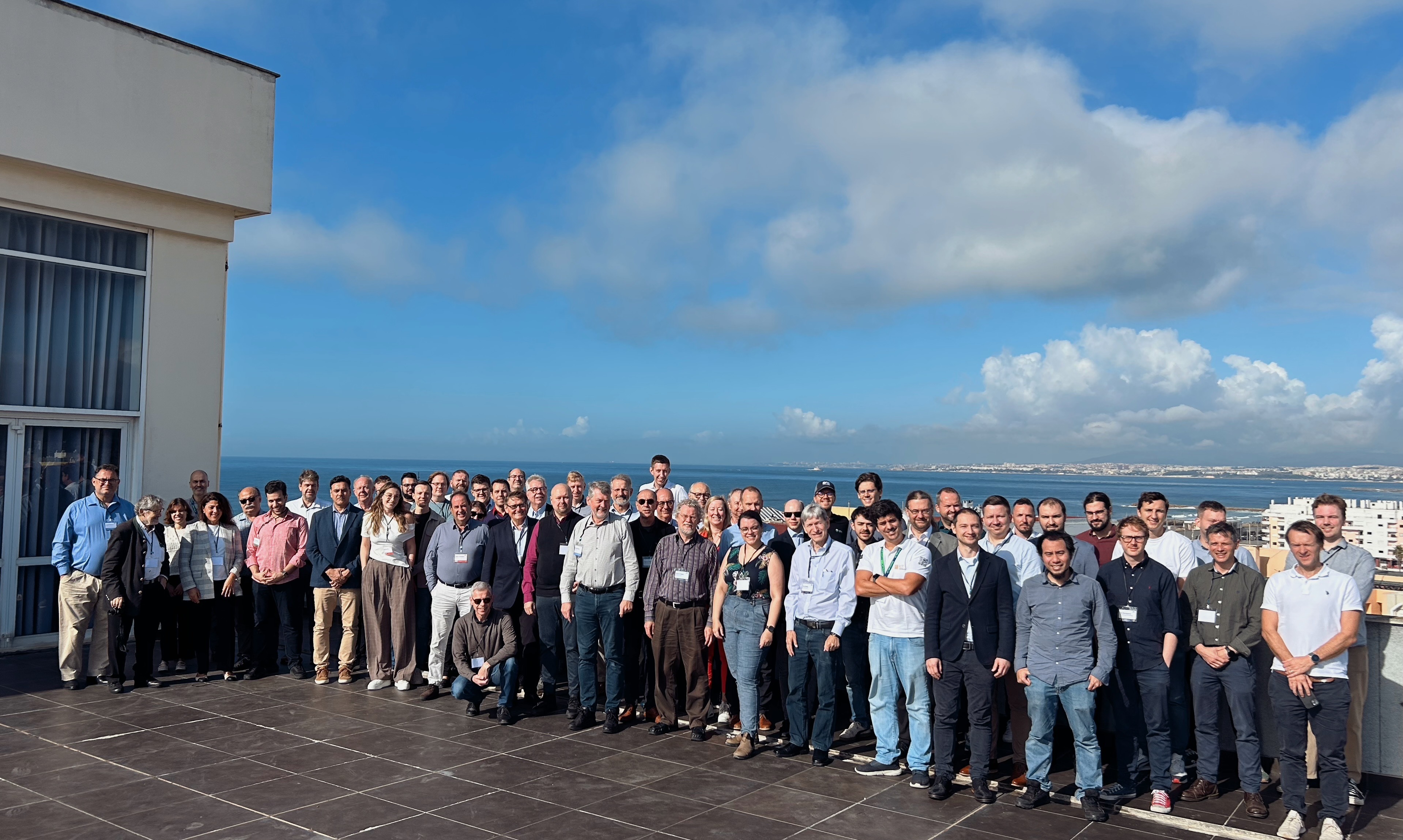
AIMS5.0 partners and reviewers at the final review meeting, hosted by TTTech in Vienna, 8–9 October 2026.
|
Partners |
Countries |
Use cases |
Average TRL |
Exploitable results |
Publications |
|
53 |
12 |
20 |
4.8 → 7.2 |
179 |
331 |
AIMS5.0 (Artificial Intelligence in Manufacturing leading to Sustainability and Industry5.0) has concluded after 41 months. Funded by the Chips Joint Undertaking and national funding authorities and coordinated by Infineon Technologies AG, the project brought together 53 partners from 12 countries to apply artificial intelligence to production in nine industrial domains, from semiconductor fabs and automotive logistics to machine tools, consumer electronics and indoor farming.
Across 20 use cases, the average technology readiness level rose from 4.8 at the start to 7.2 at the end. Of the 179 exploitable results registered by the consortium, 154 are already implemented or under test in industrial environments, and 39 have been selected as Key Exploitable Results. The final results were presented to the Chips JU and independent experts at the closing review, hosted by TTTech in Vienna on 8 and 9 October 2026.
"When AIMS5.0 started, most of our use cases were at an early research stage. Today the majority have been demonstrated in real production environments, and several results are already in daily use at partner sites. That is what becomes possible when 53 partners from industry and research work on the same problems together, from the chip to the shop floor."
Thomas Gutt, Infineon Technologies AG, AIMS5.0 coordinator
Edge hardware for AI on the shop floor (WP1)
Work package 1 developed the hardware, firmware and middleware that allow AI to run directly next to the machine. The components were designed together with the AI, architecture and platform teams and then tested in the industrial use cases.
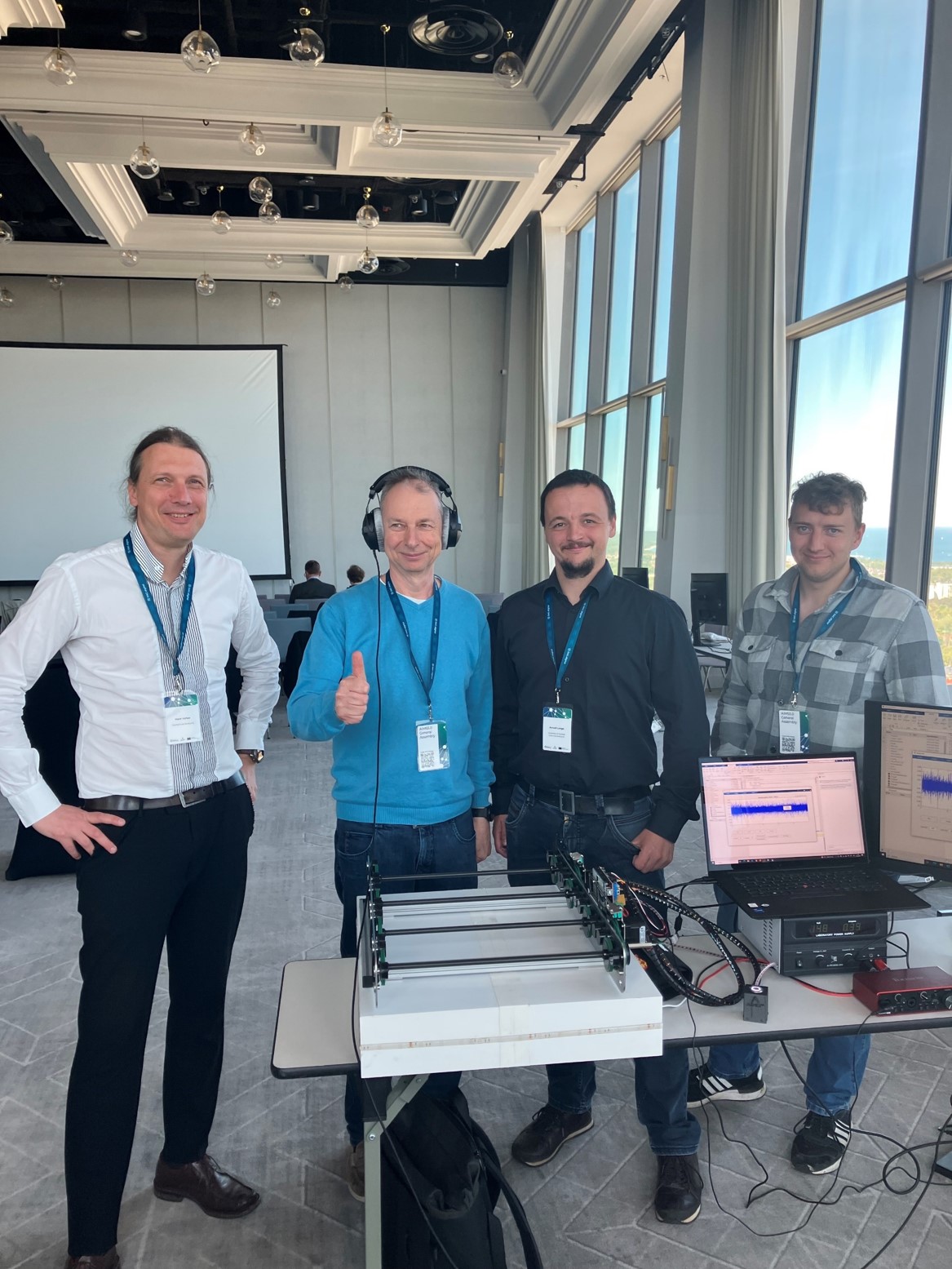
In a semiconductor fab, an improved RFID system reached 99.68% read accuracy over more than 18 million reads, and acoustic fault detection on the ceiling transport system reduces manual recovery work. Thales completed miniature RF MEMS leakage sensors with considerably lower insertion loss and power consumption than the reference design.
The StreamAnalyze edge analytics engine now runs on x86, ARM and RISC-V from a single code base. For autonomous lawnmowers, this reduced the model lifecycle effort from about 40 days to just over three. Further results include a mobile sensor platform for cleanrooms that processes 15 frames per second instead of 3.5, a perception system that lets mobile robots detect people within 5 m with more than 95% accuracy, and an EEG- and EMG-based controller for industrial exoskeletons.
AI methods and the AI Toolbox (WP2)
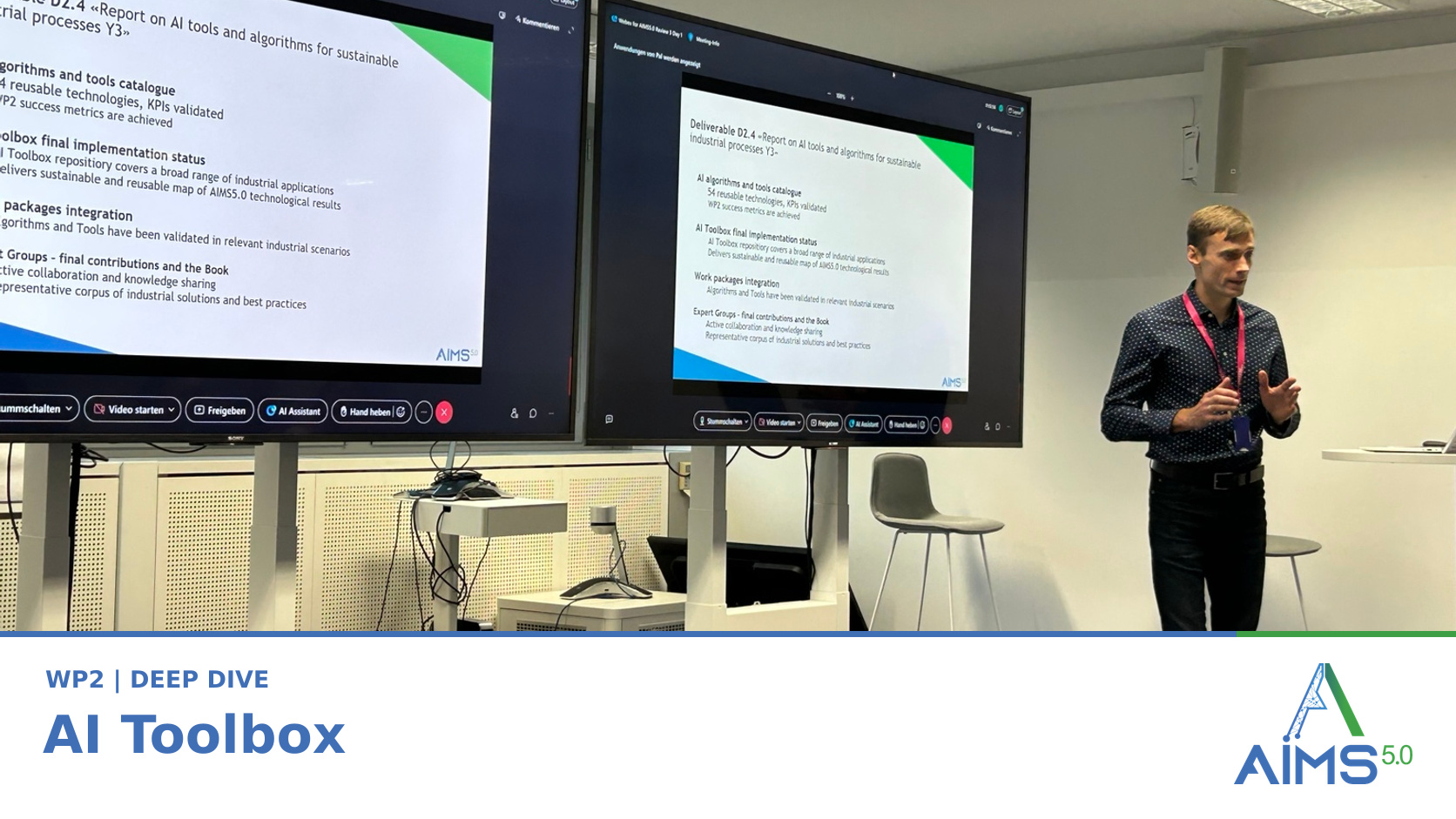
Work package 2 produced 54 reusable AI technologies, covering computer vision, anomaly detection and predictive maintenance, robotics, scheduling and optimisation, and large language models. Most of them were validated directly in the project's use cases.
The use cases provide concrete figures. A vision system for robotic conveyor feeding locates sockets with 98.7% accuracy and a position error of 2 mm. New sensors in the cleanroom cut the reaction time to contamination from eight hours to under one. At the Foundation for Research and Technology – Hellas (FORTH), machine learning halved the redesign time for RF components and reduced consumables and chemical waste by 45%. Control scripts for new robot tasks can now be generated in 30 to 45 minutes, and more than 90% of them run correctly.
The methods are documented in the AIMS5.0 AI Toolbox, a public wiki with 41 tools and 17 industrial examples that helps companies select and deploy AI. The partners have also compiled a book, AI in Industry 5.0: from Machine Learning to LLM applications.
An open architecture based on Eclipse Arrowhead (WP3)
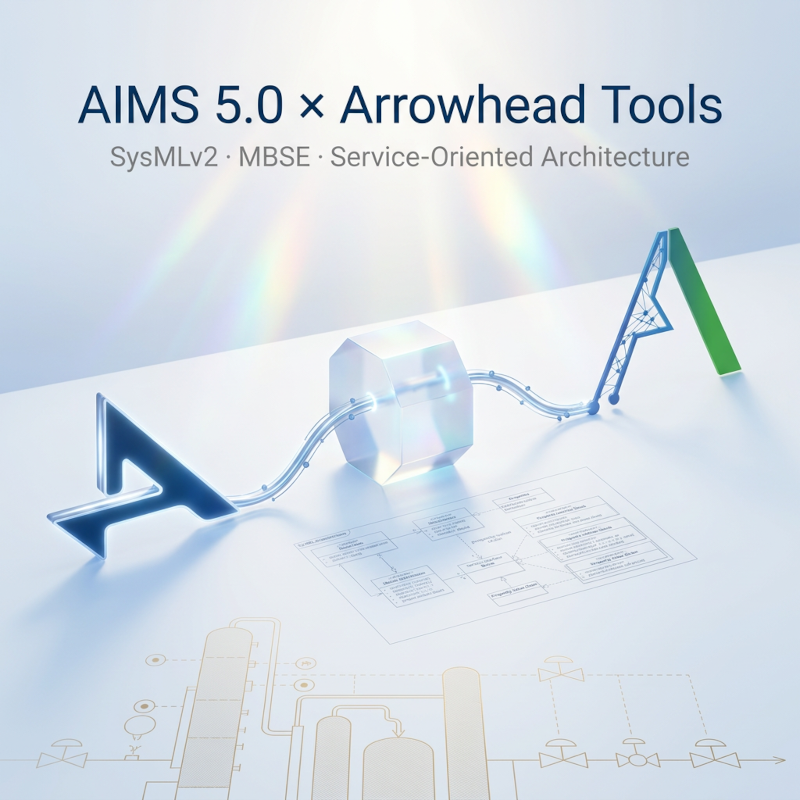
Work package 3 extended Eclipse Arrowhead, the open-source framework for service-oriented industrial automation, so that AI functions can be integrated and deployed at the edge. The project contributed to release 5.2.2, including the migration of five support systems, among them the DataManager, EventHandler and Gatekeeper, from version 4.6.
The AI-Gym, an environment for testing and validating AI components, is now available as open source within Eclipse Arrowhead. Together with the Arrowhead fPVN project, the team also developed an Arrowhead modelling language for SysML v2, which CEA, Luleå University of Technology and PTC presented at the OMG technical meeting in Reston in April 2026.
Arrowhead is already used in industry, for example in a manufacturing execution system (MES) at Scania. It is also taught in bachelor's and master's courses in Sweden, Hungary, Italy and Finland.
Digital Reference and Open Access Platform (WP4)
Work package 4 maintains the Digital Reference, an ontology designed to become the common semantic standard for semiconductors and the supply chains that contain them. During AIMS5.0 it gained three new lobes, including one for quality management, and the use cases added 641 classes to the wider ecosystem. The model can be browsed and downloaded on a public website, and a learning tool lets users explore it class by class.
The Open Access Platform builds on this model. It hosts the ontologies of 17 use cases and provides working tools on top of them. A carbon handprint tool, aligned with the Digital Product Passport and the Corporate Sustainability Reporting Directive (CSRD), compares emissions and CO₂ savings along the value chain. A simulation-based planning tool for wafer fabs was presented at the Winter Simulation Conference 2025.
The new quality model is now being evaluated for product traceability and the handling of customer complaints.
Use cases at OEMs and Tier 1 suppliers (WP5)
In work package 5, 24 partners from eight countries tested AI in eight industrial use cases. Four of the results are already in industrial use or being rolled out.
|
Use case |
Partners |
Result |
|
UC1 Green AI lifecycle |
AI Digi+ Solutions, Cetto |
CO₂ and energy monitoring tool piloted at Cetto; scenario analysis of route and e-truck options shows potential to reduce transport emissions and energy cost |
|
UC2 AI-enhanced value chain |
Philips, University of Groningen, TU Eindhoven, Semaku |
Quality dashboard in daily use on the OneBlade line to find the root causes of defects earlier; generative AI makes robotic testing of intense pulsed light (IPL) devices more human-like |
|
UC3 Servitization |
Husqvarna, Skandinaviska Enskilda Banken (SEB), Stream Analyze |
Edge AI service running at Husqvarna, cutting administration effort by more than 80% |
|
UC4 Production and logistics |
BMW, IPH Hannover, Universidad Politécnica de Madrid |
Autonomous drone scanning and much faster map creation for mobile robots, now in regular operation |
|
UC5 Machine tools |
IDEKO, Soraluce, Goimek, Savvy Data Systems, Multiverse |
Tool breakage detected within 1.5 seconds; validated on industrial milling machines |
|
UC6 Robotic conveyor feeding |
EDI (Latvia), Harokopio University of Athens |
Robot picks randomly piled bottles and places them on a moving conveyor; sockets detected with 98.7% accuracy |
|
UC7 Luminaire manufacturing |
Signify, TU Eindhoven, University of Groningen |
Metal 3D printing developed as a lower-cost alternative to die casting for luminaire parts |
|
UC8 Human-centric AI |
Smart Universal, TÜBİTAK BİLGEM |
Human-aware mobile robots and an exoskeleton controlled by brain signals; task time cut by at least 20% |
AI in semiconductor manufacturing (WP6)
Work package 6 was the largest in AIMS5.0. Thirty partners worked on 12 use cases, most of them inside European semiconductor fabs, where AI was applied to production planning, material handling, maintenance, quality control and the supply chain. Every use case delivered results, and several exceeded their targets.
|
Use case |
Partners |
Result |
|
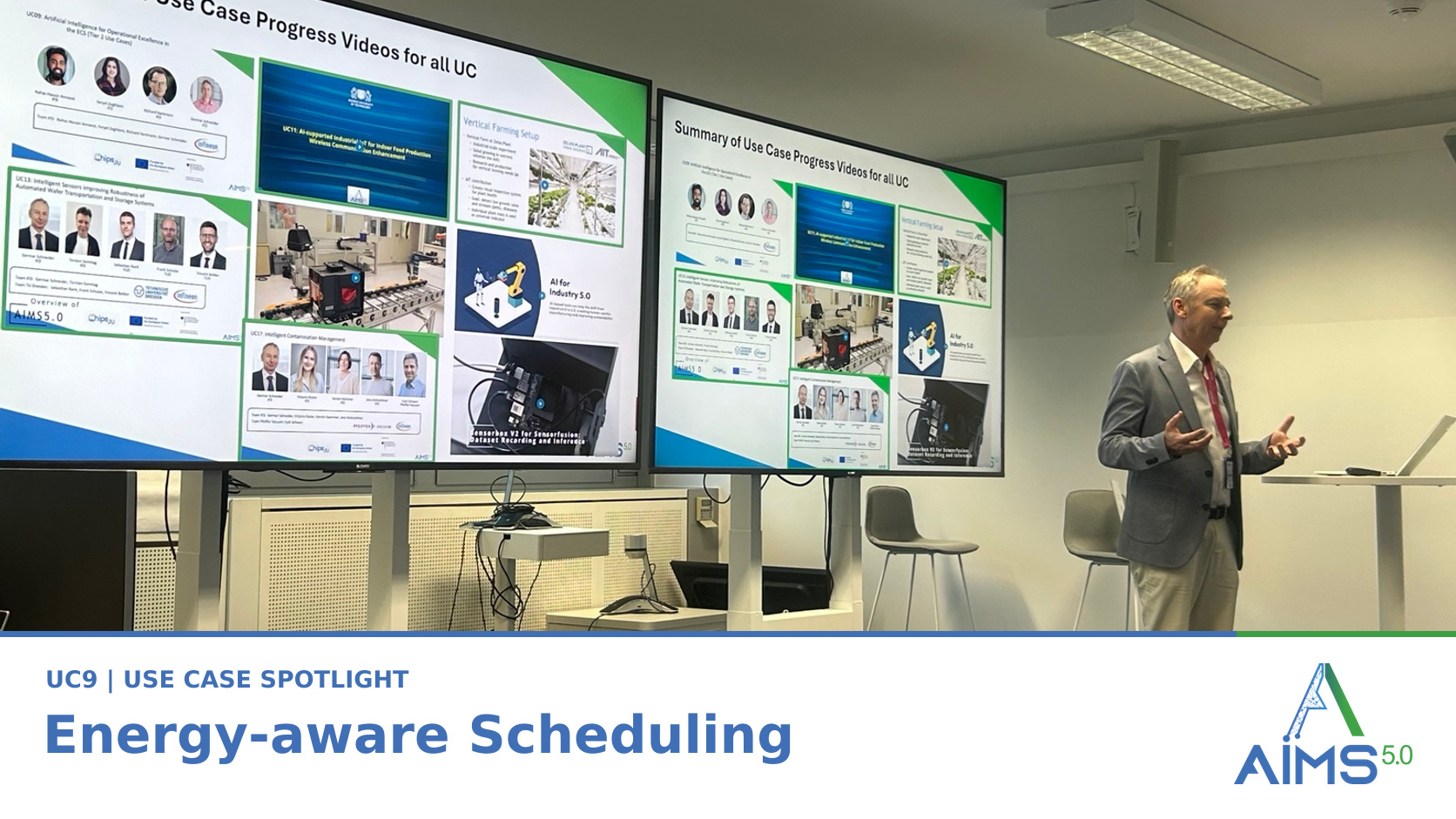
UC9 Energy-aware scheduling |
FernUniversität in Hagen, Infineon, Systema, Virtual Vehicle |
Electricity cost down of 750 kWh a day saved at high energy consuming peak situations ; anomalies in the cooling network predicted with 98.6% accuracy |
|
UC10 AI-based manufacturing execution system |
Systema, Infineon |
AI-enabled MES that connects five fab use cases; cycle time and training targets met |
|
UC11 Indoor food production |
TTTech, AIT Austrian Institute of Technology, Research Studios Austria, Zelos Plant, Gdańsk University of Technology |
Plant irregularities detected with more than 90% accuracy; adaptive antennas improve signal quality about fourfold; cybersecurity of the farm architecture assessed with ThreatGet |
|
UC12 Human-centred AI for fab networks |
WU Wien, HSZG, TU Dresden, Systema, Infineon |
Higher equipment effectiveness and less repair variability; study on how transparent AI affects workers' trust |
|
UC13 Sensors for automated wafer transport |
Hochschule Stralsund, Fabmatics, TU Dresden, Universität zu Lübeck, Infineon |
Early fault detection on transport vehicles and a mobile sensor platform for predictive maintenance lowering maintenance efforts |
|
UC14 Virtual commissioning |
Fabmatics, Hochschule Stralsund, Infineon |
Digital twins cut commissioning time by about a third; a next-generation storage system and mobile robots tested in a fab |
|
UC15 Machine learning at scale |
Infineon, University of Padova, Statwolf, LFoundry, KAI |
Shared MLOps platform: about 75% faster model development and about 25% less data needed for new machines |
|
UC16 RF transceivers |
FORTH, Thales |
Redesign time halved and chemical waste cut by 45%; all four targets met |
|
UC17 Contamination management |
Fraunhofer IISB, Pfeiffer Vacuum, Systema, Infineon |
New methods andsensors for contamination control in semiconductor factories and pilot fabs; reaction time cut from eight hours to under one hour |
|
UC18 Carbon handprint in the supply chain |
Infineon, NXP, DAC.digital, TU Eindhoven, Semaku, University of Groningen |
Semantic carbon handprint model added to the Digital Reference; around 1,000 people trained on digital supply chains |
|
UC19 Business planning and quality incidents |
NXP, Infineon, TU Eindhoven, Semaku |
Master plans generated in about three minutes with up to 40% fewer replanning changes; LLM prototype for root cause analysis |
|
UC20 Harmonised equipment control |
Infineon |
Test wafer data harmonised between two fab sites, a step towards running them as one virtual fab |
Many of these results also support sustainability: less energy at peak load, fewer test wafers, less scrap and fewer chemicals. The teams agreed on one main lesson: data availability and quality remain the biggest obstacle when AI moves from pilot to high-volume production.
Trust, acceptance and regulation (WP7)
Work package 7 examined how workers and organisations accept AI and how companies can meet the regulatory requirements. Based on 27 interviews and a survey answered by all partners, the team combined four established models into one AI assurance framework. It links each risk to a trustworthiness requirement, a control and a measure of user acceptance, and was published at IDIMT 2026.
For day-to-day use, the team developed a chatbot that checks industrial AI applications against the AI Act, the GDPR, the Cyber Resilience Act and relevant standards. Seventeen of the 20 use cases used it for self-assessment. In a comparison with legal experts on five use cases, the chatbot proved useful for a first orientation but no substitute for legal advice.
In a final survey, users rated the AIMS5.0 tools positively, with scores between 6.9 and 7.7 out of 10. Six recommendations for digital workspaces are published in the public deliverable D7.3.
Publications, standards and exploitation (WP8)
The project produced 331 publications and other dissemination outputs, more than twice as many as at the second review, and 82% of them are already published or accepted. They include 38 journal articles, 13 of them in Q1 and Q2 journals, 116 conference papers and 55 bachelor's, master's and doctoral theses. Citations of AIMS5.0 work have risen from 37 to 178.
Partners also contributed to standardisation, including IEC TC56 on dependability, IEC TC65 on human–machine collaboration and a new ISO/IEC group on Physical AI. AIT Austrian Institute of Technology leads the international work on ISO/DTS 5112, a guideline for auditing cybersecurity engineering in road vehicles.
The final exploitation register lists 179 results, 85 of them developed jointly by two or more partners. Universities and research organisations own 78. Thirty-one results are to be licensed and 13 released as open source. From the register, the consortium selected 39 Key Exploitable Results. Eight of them are shared enablers that other use cases build on, among them the Digital Reference, Eclipse Arrowhead 5.2, the Open Access Platform, the AI Toolbox and the AI-Gym.
Coordination and outlook (WP9)
The technical work was completed on 15 September 2026, and all 15 deliverables of the final period have been submitted. At the final General Assembly in Madrid in June 2026, the partners showed their results at more than 40 demonstrator stands. Throughout the final year, AIMS5.0 worked closely with the Chips JU projects SC4EU and Arrowhead fPVN.
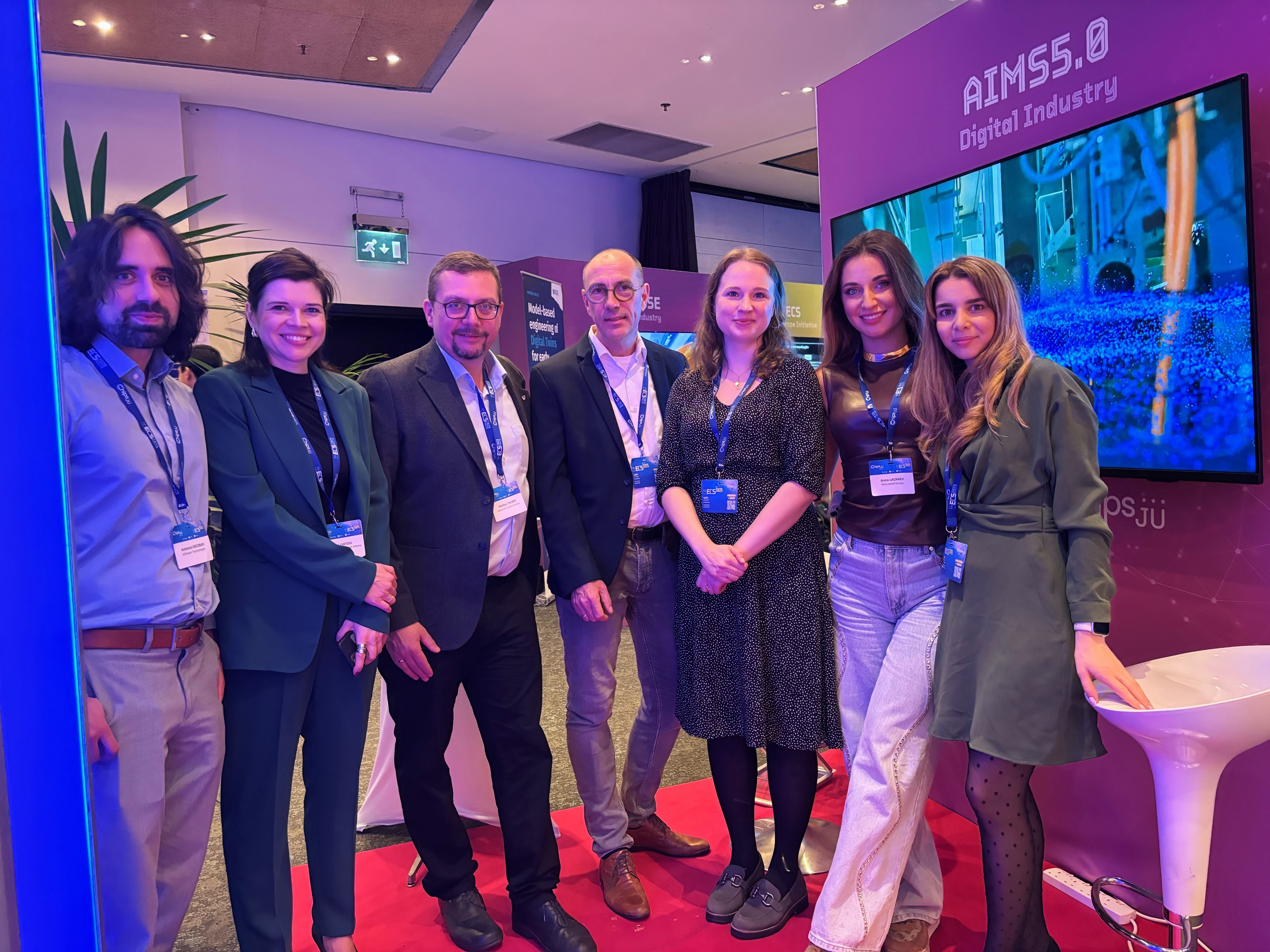
The results remain publicly available on aims50.eu, including 26 articles, 17 public deliverables and 27 videos, and further use case videos will follow in the coming weeks. AIMS5.0 will present its results at its own booth at EFECS 2026 in Helsinki on 2 and 3 December.
Explore the results
About AIMS5.0
AIMS5.0 ran from May 2023 to September 2026 under the Chips Joint Undertaking. Coordinated by Infineon Technologies AG, a consortium of 53 partners from industry, SMEs, research organisations and universities in 12 European countries developed and validated AI-based hardware, software and methods for sustainable, resilient and human-centric manufacturing. Public deliverables, use case videos and project news are available at aims50.eu.
The AIMS5.0 project is supported by the Chips Joint Undertaking and its members, including top-up funding by National Funding Authorities from involved countries under grant agreement no. 101112089. The participating countries are Austria, France, Germany, Greece, Hungary, Italy, Latvia, Netherlands, Poland, Spain, Sweden and Turkey.



 Imprint
