April 02 2026
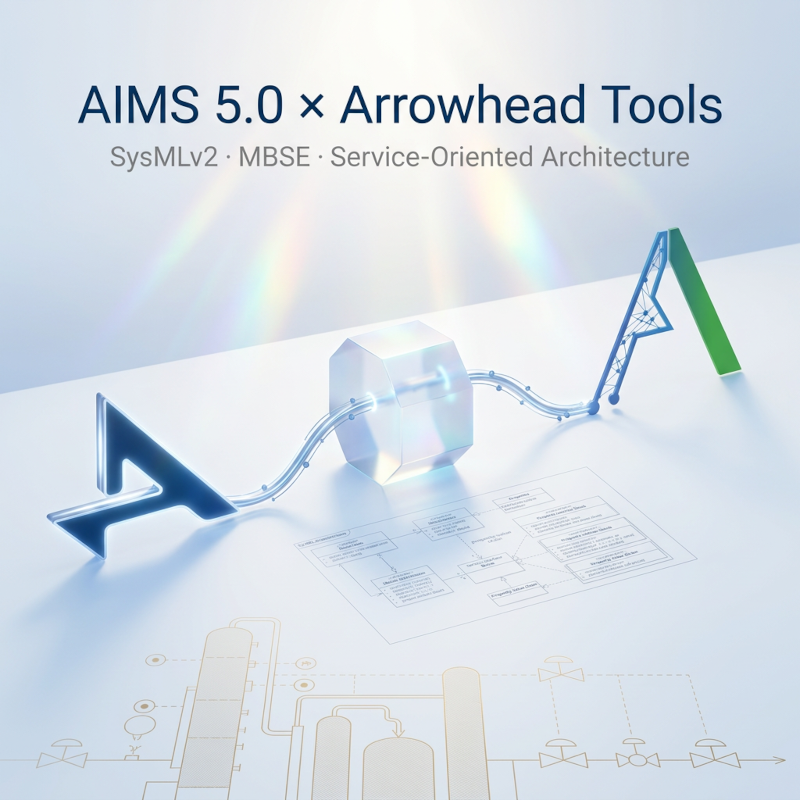
SysMLv2 Library for SOA: Arrowhead Work Highlighted in the Context of AIMS5.0 Collaboration
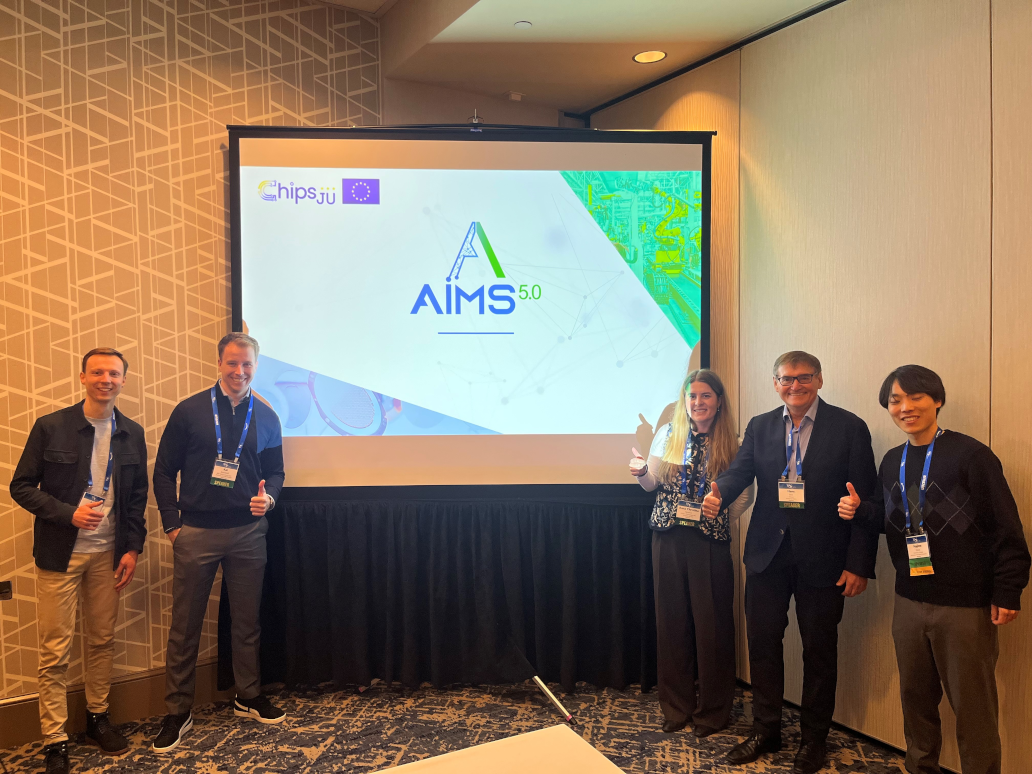
At the OMG technology meeting in Reston, Asma Smaoui (CEA), Jerker Delsing (LTU), and Géza Kulcsár (PTC) presented ongoing work on the ‘SysMLv2 library for SOA’, based on MBSE activities in the Arrowhead fPVN and AIMS5.0 projects. The resulting Arorwhead DSL (Domain Specific Language) is applicable to integration of AI and automation into production and products.
What the presentation focused on
The presentation followed a clear technical path. It introduced the background and resources behind the work, revisited the SysML v1.6 version of the Eclipse Arrowhead DSL, reviewed previous and updated versions of the Arrowhead SysMLv2 library, and explained the translation path from Arrowhead DSL based in SysMLv1 to SysMLv2. It also included concrete use cases, current work related to integration with ISO 23726-3, and forward-looking perspectives.
Building on established Arrowhead foundations
A central message of the session was continuity. The first versions of the Eclipse Arrowhead DSL were developed in the EU project Arrowhead Tools using SysML v1.6. The presentation further explained that the SysML v2 DSL version and the Arrowhead core system library were primarily developed by Oystein Haugen, mainly using the Eclipse Papyrus tool. This shows a consistent evolution from earlier modeling approaches toward a more advanced SysMLv2 environment.
The engineering logic behind this work remains closely connected to the Eclipse Arrowhead engineering process, which is based on ISO 81346 and exploits service-oriented architecture. This connection is important because it links structured engineering practice with interoperable system design, which is highly relevant for modern industrial environments.
From SysML v1.6 to SysMLv2
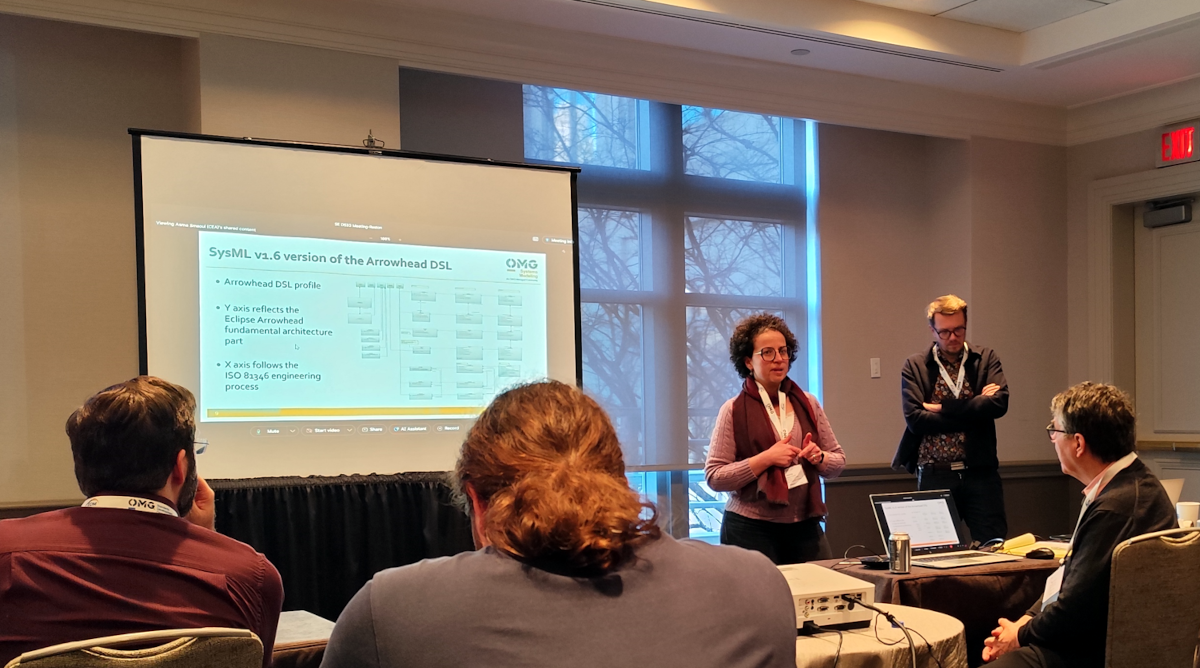
The presentation described the Eclipse Arrowhead DSL profile as a framework in which the Y axis reflects the Eclipse Arrowhead fundamental architecture part, while the X axis follows the ISO 81346 engineering process. This creates a modeling structure that connects architecture and engineering workflow in one consistent view.
The updated SysMLv2 library reflects Eclipse Arrowhead v5.2 and includes both core systems and support systems. It also follows the Eclipse Arrowhead engineering process across black box architecture, white box architecture, and implementation. In practical terms, this makes the library relevant not only for system representation, but also for the full development path from concept to implementation.
A practical translation workflow
A particularly useful part of the presentation was the explanation of how the transition from SysMLv1 to SysMLv2 is being handled. The mapping from SysMLv1 to SysMLv2 for the Arrowhead DSL is supported through a translation implemented in Papyrus. According to the presentation, this translation is based on Xtend templates, uses the Papyrus UI to launch the translation from a UML file, creates a SysMLv2 project with references to SysML libraries, and generates a .sysml file that can be imported into SysOn or Cameo for improved diagrams.
The workflow itself was presented in a very direct way: create the Arrowhead Library, run the translation, and generate the .sysml from the .uml. Even in this concise form, it represents an important enabling step for broader adoption of SysMLv2 in complex industrial and system-of-systems settings.
Use cases and wider impact
To demonstrate practical relevance, the presentation included a smart city lighting system use case with three generations of smart light technology. The example features detection of presence, direction, and speed, while enabling lighting for an estimated movement trajectory. This helps translate the modeling work into a concrete application context.
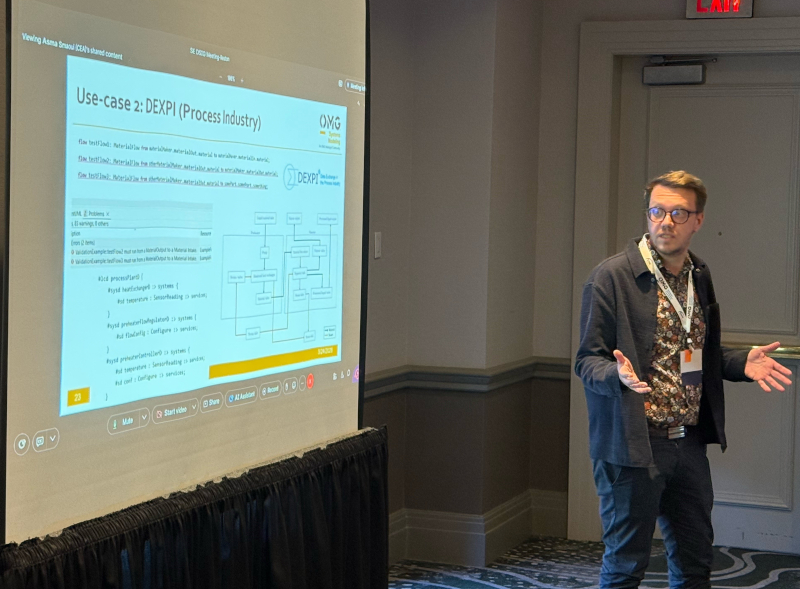
A second use case focused on DEXPI in the process industry. This was linked to a broader inter-standard discussion involving SysML v2, ISO, IDO, STEP, the Arrowhead Framework Ontology, the Industrial Data Ontology, OWL, traceability, consistency and correctness, lifecycle management, inference V&V, and use-case knowledge graphs. Together, these elements show that the work goes beyond one library and contributes to broader questions of semantic interoperability and digital engineering.
The presentation also pointed toward lifecycle management and digital threads, describing a direction toward a SOA digital engineering platform built around the Eclipse Arrowhead SysML v2 library, system-of-systems models, and domain libraries. It further highlighted LLM-assisted ontology engineering, noting that LLMs can support tasks such as abstraction level identification, meta-level flattening from MOF to TBox or ABox, cross-ontology alignment and mapping, fixing inconsistencies, and TBox or ABox gap reasoning.
Conclusion
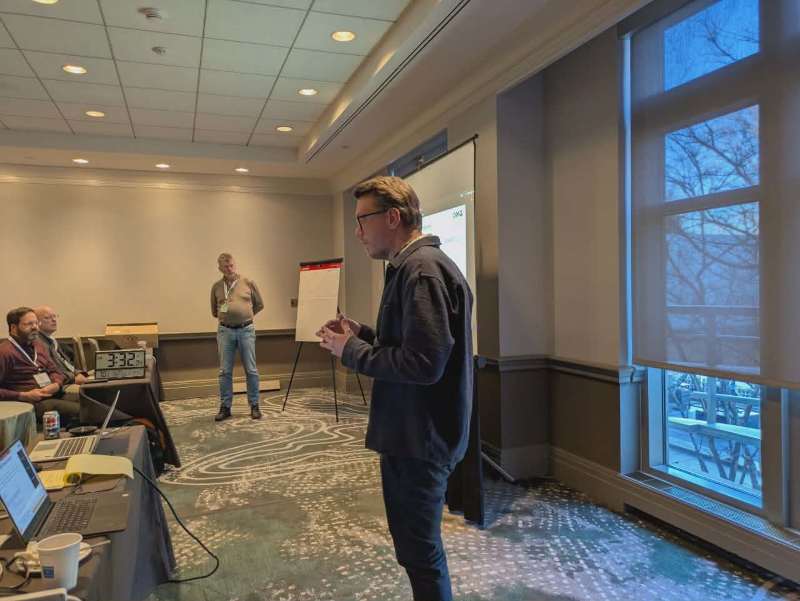
Presented by Asma Smaoui (CEA), Jerker Delsing (LTU), and Géza Kulcsár (PTC), the session highlighted important ongoing work on the SysMLv2 library for SOA within the Eclipse Arrowhead context. Beyond the technical progress itself, it also showed how collaboration between connected initiatives can strengthen shared understanding and create valuable links across projects. In this sense, the exchange also stands as a relevant point of connection between Arrowhead fPVN and AIMS5.0 projects, reflecting a broader spirit of cooperation around industrial digitalisation, interoperability, and advanced engineering approaches.



 Imprint